



20 May Money Thoughts – Q2 2026
 The DLD Financial Q2 2026 newsletter covers Alberta’s Bill 11 and its impact on employer group benefits, including expected cost increases and changes to coverage rules. It also provides a markets update highlighting Canadian equity exposure, broader diversification through commodities and alternative assets, and ongoing active risk management. Additional sections include fraud prevention guidance and recent media features on financial scams and behavioural finance.
Significant Group Benefits UPDATE regarding Alberta Bill 11a
Last fall, Alberta introduced Bill 11, which reshapes how health services are funded and delivered across the province. This bill has significant implications for employers who sponsor group benefits for Alberta-based employees.
Currently, an employer’s group benefit plan can terminate or reduce drug and health coverage when an employee turns 65. This means the employee would subsequently rely on the Alberta provincial health plan. However, when Bill 11 takes effect, employers will no longer be allowed to terminate or reduce coverage based on age. The employer must provide group benefits for the employee as long as they work for the company.
Once Bill 11 comes into effect, the employer-sponsored plan will become the first payer, and the provincial plan will become the last payor for drug and supplemental health benefits. Also, currently, employer-sponsored plans don’t cover publicly insured physician services so the province handles these costs allowing employer plans to fill the gaps. With Bill 11, private insurers will cover some medically necessary physician costs. This includes physician visits, diagnostic tests and some physician-performed treatments.
These changes will significantly increase costs for employers and their benefits plans. 64% of global employers say cost control is their number one priority. Most significantly, insurance companies will increase stop-loss and high-amount healthcare pooling rates because drug and health claims are shifting from the provincial plan to employer-sponsored benefits plans. Employers who also offer drug and health coverage to their retirees will see an impact as well depending on the number of employees and active employees over the age of 65.
How we can help manage the impact of Bill 11:
– Review your prescription drug plan: consider switching to a different formula or introducing annual/lifetime maximums
– Review reimbursement levels; the goal is to help offset increased costs while maintaining reasonable coverage for employees
– Audit ENTIRE current benefits plan – we already do this regularly for all managed plans.
– Group benefits are not something to review only once a year. Our most important goal for client benefits is containing costs and ensuring consistency.
What differentiates us:
– Full disability and safe management services for companies that meet the minimum number of employees
– A six-year no-renewal model designed for long-term stability
Get in touch with us for a second opinion!
E&OE

State of the Markets: Tactical Corporate Class Portfolio Update
MORE CANADA – LEVERAGING A RESOURCE-RICH ECONOMY
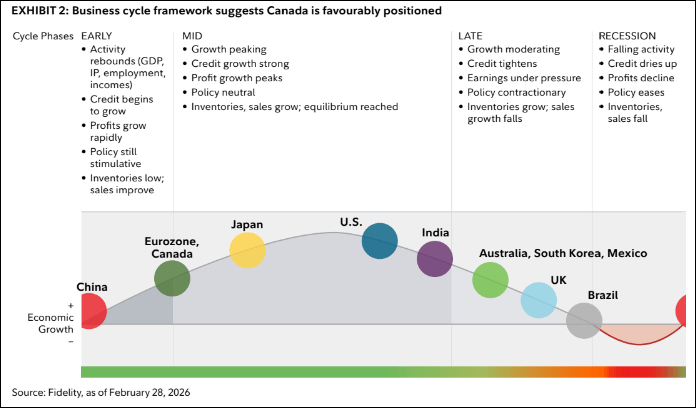
- A global “scramble for resources” is increasing the value of reliable commodity producers with Canada well positioned.
- Canadian equities are highly leveraged to commodities, with materials and energy making up a significant portion of the market.
- While the domestic economy remains soft, we may be past peak weakness, with improving conditions supported by investment and policy tailwinds.
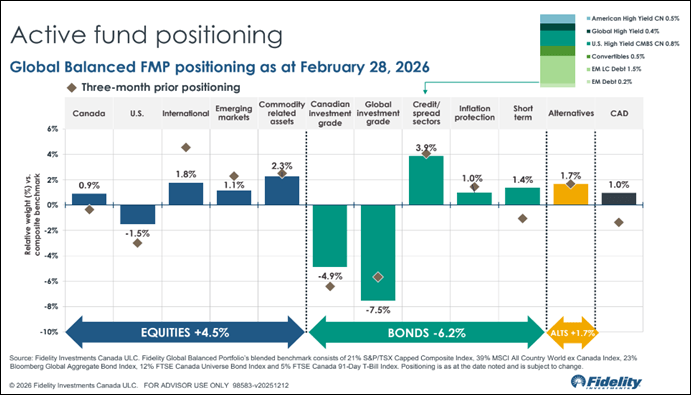
- Positioning: Overweight Canadian equities and the Canadian dollar, reflecting improved relative opportunities
BROADER DIVERSIFICATION – IN AN INFLATIONARY REGIME
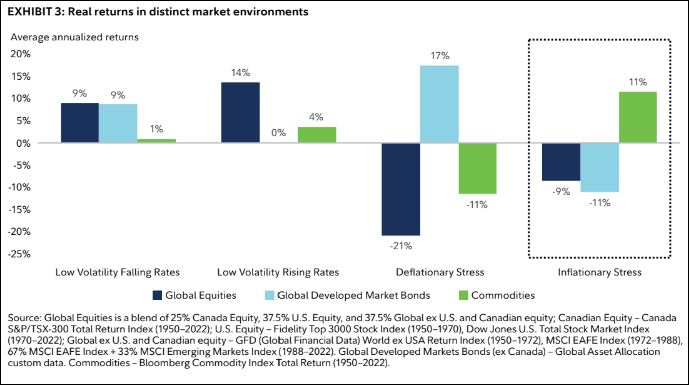
Inflation shocks challenge the traditional relationship between stocks and bonds, reducing the effectiveness of bonds as a hedge.
The team continues to broaden diversification through:
- Commodities and gold
- Recently launched a commodity futures strategy for broad exposure to a basket of commodities (only available through the Managed Portfolios)
- Inflation-focused strategies
- Like Fidelity Inflation Focused Fund (up 8.3% through Q1)
- Currencies and alternative asset classes
- These exposures aim to provide resilience when traditional assets struggle simultaneously.
Risk Management Remains Critical
- Markets have been resilient to recent shocks, but that resilience cannot be taken for granted.
- The team has taken advantage of earlier market strength to modestly reduce risk while maintaining a slight overweight to equities.
- Strong corporate earnings remain supportive, but uncertainty around geopolitical outcomes remains high.
Key Takeaways
- Geopolitical conflict is inflationary: Driving commodities higher and challenging traditional portfolios.
- Commodities are back in focus: Providing both return potential and diversification benefits.
- Canada stands out: Benefiting from resource strength and improving cyclical positioning.
- Diversification is evolving: Broader exposure beyond stocks and bonds is increasingly important.
- Active risk management matters: Positioning remains flexible in a highly uncertain environment.
Source: Fidelity Investments

Fraud Prevention
At DLD, we take as much precautions as possible to protect your information. For example, when clients make a redemption request, we require verbal confirmation. When we email you documents, they are encrypted. Here are some more tips on how to protect yourself:
Source: Canada Life
YouTube Video Feature: Retiring Early in Canada? Watch This Before You Do
Retiring early in Canada is still possible. But the tax landscape in 2026 is creating new challenges that many retirees are completely unprepared for. And the people getting hurt most are often the ones who did everything “right” during their working years.
– Maximized their RRSPs.
– Built large investment portfolios.
– Saved consistently for decades.
Because once retirement begins, taxes, RRSP withdrawals, capital gains, CPP, OAS, and RRIF rules all start interacting at the same time. In this video, I break down the biggest early retirement tax traps Canadians need to understand in 2026, why so many retirees accidentally overpay tax, and the planning strategies affluent Canadians use to improve retirement flexibility and reduce long-term tax exposure.
If you’re planning to retire early in Canada, understanding how capital gains, RRSPs, TFSAs, OAS clawbacks, CPP timing, and withdrawal sequencing all interact could potentially save you tens or even hundreds of thousands over retirement.

DLD in the Media
- 5 Financial Scams that look too damn real – Neo Financial
- Helping Adult Children with a Large Expense – FP Canada
- Closing the Money Behavior Gap – Advocis Coffee Talks
Please do not hesitate to contact us if you have any questions or if there’s anything we can do to help. Thank you for your time and from all of us at DLD.
Warmest regards,
Dave, Kelly, Ryan, Aaron and Ian
E&OE