

19 Nov Money Thoughts – Q4 2026
 The DLD Financial Q4 2026 newsletter breaks down key Federal Budget 2026 updates – including the proposed May 15 tax deadline, merged RRSPs/RRIFs, and $250,000 deposit insurance – alongside diversification lessons from Nvidia-driven market volatility, January 2027 Total Cost Reporting (TCR), and recent firm news.
Federal Budget 2026 Highlights – Key Takeaways
The government is betting big on growth.
Roughly two-thirds of the $152B in net new spending is aimed at making Canada a more attractive place to invest. The centerpiece is the Productivity Mega Deduction ($36B over 5 years), which significantly expands tax breaks for businesses investing in equipment and innovation.
Energy and resources remain a key priority.
$9B over 5 years is directed toward the National Electricity Strategy, including expanded cleantech and clean energy tax credits, critical minerals support, and new forestry funding. The government’s push to streamline major project approvals signals a more business-friendly regulatory environment overall.
Near-term relief for everyday costs.
A one-time grocery top-up, a continued fuel tax cut, and $11B over four years to address homelessness and housing. Combined, the grocery and fuel measures alone deliver roughly $7B in near-term relief.
Defence commitments are stepping up.
With limited new measures this year following last year’s push to reach NATO’s 2% target, the government has laid out a clear path — raising core defence spending to 2.6% of GDP and total defence and security spending to 4.1% by FY27/28, on the way to NATO’s agreed targets of 3.5% and 5% by 2035.
The deficit is manageable, but borrowing is rising.
New spending is largely offset by $158B in additional fiscal room, mostly from stronger tax revenues. However, the deficit ticks up to 1.8% of GDP this year, debt levels rise modestly over the next two years, and rising interest rates mean public debt charges are on track to hit their highest share of revenue since 2007-08.
Practical wins for personal finances.
RSPs and RRIFs will be merged into a single, simplified account, deposit insurance protection doubles to $250,000, and the tax-filing deadline moves to May 15. Canadians will also have the opportunity to invest directly alongside the government’s new $25B Canada Strong Fund
Modernising the Deposit Insurance Framework
Budget 2026 proposes to amend the Canada Deposit Insurance Corporation Act to modernise Canada’s deposit insurance framework. The proposed changes would increase the deposit insurance limit from $100,000 to $250,000, provide temporary higher balance coverage for certain life events such as the sale of a home, and remove the deposit insurance limit for eligible deposits held in registered and tax-free accounts.
Individual Measures
RRSPs for Life – Budget 2026 announces the government’s intention to merge the core features of the RRSP and RRIF under the Income Tax Act into a single “RRSP for life” and make other changes to modernize the RRSP rules. This would eliminate the need for individuals to convert their RRSP to a RRIF at age 71. Individuals over age 71 would continue to be required to make minimum withdrawals. They are also considering on how a RRSP could include a “successor holder” feature for a spouse or common-law partner, potentially allowing the RRSP to remain open until the successor holder’s death and whether the existing indirect rollover rules on death could be replaced by direct tax-free transfers to qualifying registered vehicles of qualifying survivors.
Income Tax Return Filing and Balance-Due Dates for Individuals
Budget 2026 proposes to change the T1 filing and balance-due dates to May 15 for all individuals, including self-employed individuals and their spouses or common-law partners.
Installment Payments for Individuals and Corporations
Most individuals may be required to make quarterly income tax installments if their combined federal-provincial net tax owing exceeds $3000 for the current year and either of the two previous tax years. Budget 2026 proposes to increase the threshold from $3000 to $7500 for corporations and individuals. The thresholds would be indexed to inflation and rounded to the nearest $500 and any remaining tax payable for a taxation year would be due on the applicable balance-due date. Budget 2026 also proposes that individuals whose primary source of income is from a business, including professional or commission income, be allowed to make a single annual installment payment instead of quarterly installments. The single installment would equal two thirds of their combined federal-provincial net tax owing for the year and be due by December 31 and the remainder would be due on the applicable balance-due date.
Optional Flat Amounts for Personal Income Tax Deductions and Credits
To reduce the need for individuals to retain receipts and itemize certain expenses, Budget 2026 proposes optional flat-amount calculation methods for certain deductions and credits. Individuals would still need to establish their eligibility. Key proposed amounts include:
- Moving Expense Deduction: An optional $1,000 deduction for an eligible relocation instead of tracking and claiming actual deductible moving expenses.
- Clergy Residence Deduction: An optional $1,000 deduction for each month of eligibility, up to $12,000 annually.
- Labour Mobility Deduction for Tradespeople: An optional $1,500 annual deduction for eligible tradespeople and apprentices undertaking an eligible temporary relocation.
- Home Accessibility Tax Credit: A one-time optional flat-expense amount of $1,000 instead of claiming actual qualifying expenses, subject to the applicable conditions.
- Adoption Expense Tax Credit: An optional flat-expense amount of $1,200 per adopted child in the year an adoption is completed. These measures would apply to the 2027 and subsequent taxation years.
Medical Expense Tax Credit and Disability Supports Deduction
The Medical Expense Tax Credit (METC) and Disability Supports Deduction (DSD) generally require individuals to retain receipts and, depending on the expense, obtain a prescription or certification from an authorized medical practitioner. Budget 2026 proposes to simplify the documentation requirements for certain expenses. For expenses incurred exclusively for medical purposes, the prescription requirement would be removed, with no certification of the individual’s medical condition required. For certain expenses that may also be incurred for non-medical purposes, the prescription requirement would be replaced with certification of the individual’s medical condition by an authorized medical practitioner. Budget 2026 also proposes optional flat amounts, including $1,000 for gluten-free food expenses associated with celiac disease, $500 for eligible incontinence products and $2,000 for expenses related to a service dog. The gluten-free food measure would apply to the 2026 and subsequent taxation years, while the incontinence product and service-dog measures would apply to the 2027 and subsequent taxation years.
Business Measures:
Canada Growth Incentive – Capital Gains Exemption
Budget 2026 proposes to introduce a new Canada Growth Incentive (CGI) capital gains exemption that would allow a Canadian-resident individual to claim an exemption on capital gains realized on the disposition of qualifying shares of a qualifying corporation, up to a $15-million limit for each qualifying individual in respect of each business. Key eligibility requirements include:
- Individual: The individual must generally be at least age 18 when the shares are acquired and resident in Canada throughout the year in which the exemption is claimed.
- Corporation and qualifying business assets: The corporation must be a Canadian-controlled private corporation when the shares are issued. At issuance, all or substantially all of the fair market value of its assets must generally be attributable to assets used, or reasonably intended to be used within 36 months, principally in a qualifying business carried on primarily in Canada. The combined assets of the corporation and related corporations must not exceed $100 million at issuance.
- Ongoing asset test: While the shares are held, at least 50% of the fair market value of the corporation’s assets must generally be attributable to assets used principally in a qualifying business.
- Holding period and Canadian business: The shares must generally be held for at least 36 consecutive months before disposition, and the qualifying business must generally be carried on primarily in Canada for at least 24 consecutive months after the shares are issued. At the time of disposition, all or substantially all of the fair market value of the corporation’s assets must be attributable to assets used principally in a qualifying business.
- Excluded businesses: Certain businesses would not qualify, including specified consulting and professional practices and businesses in certain sectors such as agriculture, fishing, forestry, mining, financial services, insurance, utilities, real estate, food and accommodation, arts, recreation and entertainment. Businesses operating under licensing or franchising agreements would also be excluded. Capital gains exempted through the CGI would be subject to a 30% inclusion rate for Alternative Minimum Tax purposes. A CGI exemption claimed on qualifying shares of a corporation would limit the individual’s ability to claim the Lifetime Capital Gains Exemption on shares of the same corporation, and vice versa.
This measure would apply in respect of qualifying shares of a qualifying corporation issued on or after Budget Day and before 2037.
Individual Pension Plans
An individual pension plan (IPP) is generally a defined benefit RPP with fewer than four members where at least one member is related to a participating employer. IPPs currently are not subject to the advantage, prohibited-investment and non-qualified-investment rules that apply to certain other registered plans. Budget 2026 proposes to expand the definition of an IPP to include defined benefit RPPs in which all members are either related to a participating employer or do not deal at arm’s length with a member related to a participating employer.
IPPs would also become subject to the non-qualified investment, prohibited investment and advantage rules applicable to other registered plans of controlling individuals. In addition, an IPP whose assets exceed 200% of its pension liabilities would become a “revocable plan,” with the CRA required to provide at least 30 days’ notice before issuing a revocation letter to allow time for corrective action.
The expanded IPP definition would apply as of January 1, 2027. The non-qualified investment, prohibited investment, advantage and excessive-surplus measures would apply as of January 1, 2028, subject to applicable transitional rules.
Canada Growth Incentive – Rollover for Investments in Small Businesses
Individuals may currently defer capital gains on qualifying dispositions of eligible small business corporation shares where the proceeds are reinvested in replacement eligible small business corporation shares in the year of disposition or the following calendar year.
Budget 2026 proposes to extend the replacement period to the three calendar years following the year of disposition, with up to an additional two years where an individual enters into an eligible agreement for future equity. It also proposes to lower the active-business asset threshold that must generally be met during the shareholding period from “all or substantially all” to “primarily.”
These measures would apply to qualifying dispositions that occur on or after January 1, 2027.
Corporate Loss Transfers
Canadian corporations are generally taxed on a standalone basis and cannot directly deduct losses incurred by another corporation. Corporate groups can undertake transactions such as amalgamations, wind-ups or intragroup financing to effectively transfer losses, although these arrangements can be complex or impractical. Budget 2026 invites stakeholder comments on a proposed corporate loss-transfer mechanism that would generally permit transfers of current-year non-capital losses between a parent corporation and a directly or indirectly wholly owned subsidiary, or between two subsidiaries directly or indirectly wholly owned by the same parent. The transferor and transferee would make a joint election, allowing the transferee to deduct the elected amount with a corresponding reduction to the transferor’s current-year non-capital loss. Budget 2026 does not specify an effective date for the proposed corporate loss-transfer regime.
Sources: Mackenzie Investments and RBC Global Asset Management
What about Nvidia?
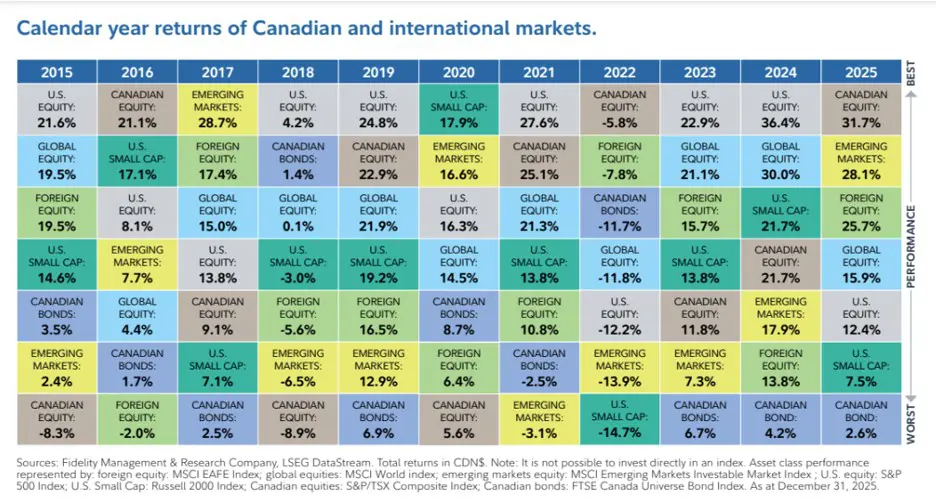
Recent Market Volatility due to Nvidia re-emphasized the importance of diversification. The chart below illustrates the geographical leaders for the last 10 years – you never know who will do well!
We also thought it would be helpful to show a history of what happens after a downturn:
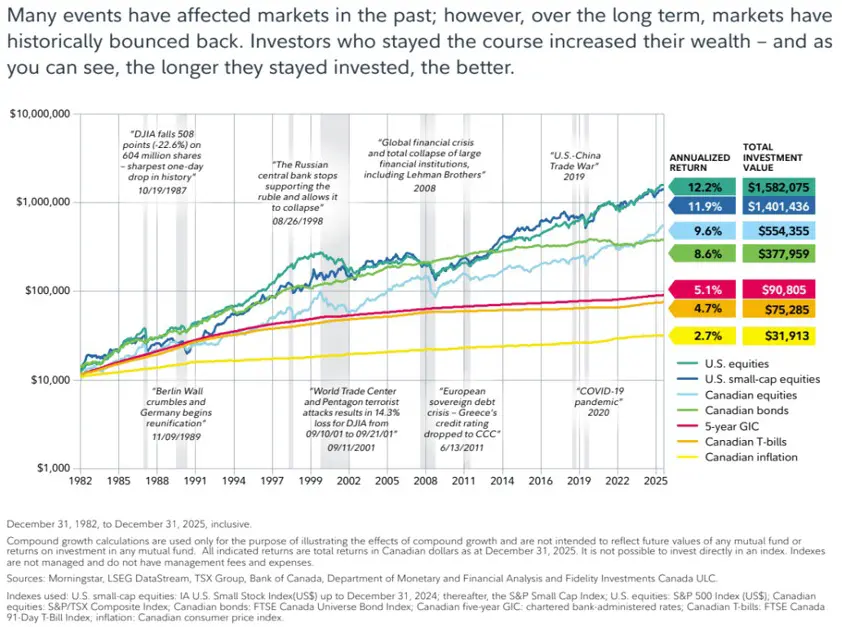
Source: Fidelity Investments

Total Cost Reporting on January 2027 Investment Statements
New regulations called Total Cost Reporting (TCR) will appear on annual statements for 2026, delivered in 2027. These rules provide greater transparency by showing investment costs in dollars, not just percentages.
Definitions
- Management Expense Ratio (MER): The percentage of a fund’s assets that covers management, administration and other operating costs including provincial and federal taxes. This is deducted from the fund’s assets before performance is calculated.
- Trading Expense Ratio (TER): The percentage of a fund’s assets that covers trading costs for buying and selling securities – also deducted from returns.
- Fund Expense Ratio (FER): FER = MER + TER
These two components represent the total cost of owning a fund.
Breaking down the MER
MER typically includes:
- Investment management fees: This compensates the fund manager for their work including research, making investment decisions, daily monitoring, supervising the fund and ensuring the portfolio aligns with objectives.
- Trailing commissions (or trailer fees): Fund companies pay these ongoing fees to Investment Representatives for their service and advice. Typically, this is a fixed percentage of the fund’s assets.
Note: For fee-based platforms, trailing commissions aren’t paid by the fund manager. Instead, the Investment Representative’s Dealer charges a negotiated fee to the investor. - Operating expenses: Each fund pays an administrative fee that covers day-to-day costs like recordkeeping, customer service, legal and audit fees and regulatory compliance.
- Taxes: Mutual funds are required to pay provincial and federal taxes applicable to the fees charged by the fund.
MER is automatically deducted from the fund’s assets, reducing returns rather than appearing as a separate charge. For example: If a fund earns 8% and has an MER of 2%, the net return is 6%. MER is accrued daily and paid monthly, so its impact is spread over time.
TER represents the cost of buying and selling securities in the fund:
- Higher for actively managed funds
- Lower for balanced or fixed-income funds
- Deducted from returns like MER
Sample fund fee breakdown
If you invests $10,000 in a mutual fund with an MER of 1.7%, the annual cost is about $170, broken down as:
- $75.50 for professional management and operating expenses
- $4.50 for taxes
- $90 for dealer services and advice from your advisor
Fees aren’t changing under TCR. Client statements will simply be more transparent about fees starting in 2027.
*For clients who are invested in the Constellation Portfolios – there have recently been substantial fee reductions – your advisor will advise at your next review meeting.*

DLD in the Community
This summer, we volunteered with a local organization – Quest Non-Profit Grocery Markets. Our staff asked if we can organize a day to volunteer in the community with our firm – how lucky are we?!
Quest Outreach Society exists to disrupt the cycle of food insecurity through access to healthy and affordable food that is sourced sustainably. By bridging the gap between food banks and traditional grocery stores, Quest provides a grocery experience based on principles of dignity, access and sustainability.
We had an amazing experience!
DLD in the Media
- What advisors are telling clients about Prediction Markets – The Globe and Mail
- Can’t afford your kids’ summer camp anymore? – CBC News – The National
- Thinking of a used laptop to save on costs? – The Canadian Press
- Canada’s Interest Rate Prediction – Global News
- Women in high-income families more likely to have children, StatsCan finds – The Globe and Mail
- What does retirement mean to you? CBC Radio One
- What the Bank of Canada’s Rate hike mean for your money – The Canadian Press
We consider feedback a gift!
If you’ve enjoyed working with our team, we’d be grateful if you took a moment to share your experience with a Google Review.
Your feedback not only helps others learn about DLD Financial Group, but also helps us continue providing the high level of service our clients expect.

As always, if you have any questions or there’s anything we can do to help, please don’t hesitate to reach out. Thank you for your continued trust and support. From all of us at DLD Financial Group, we appreciate the opportunity to be part of your financial journey and we wish you a wonderful holiday season!
Warmest regards,
Dave, Kelly, Ryan, Aaron
E&OE